Baby & Child Safety · 1 – 2 years
Door safety for toddlers: finger traps, handles and wandering
How to protect little fingers from closing doors, keep toddlers out of rooms with hazards, handle fire doors correctly and keep escape routes clear, using NHS, HSE and UK fire service advice.
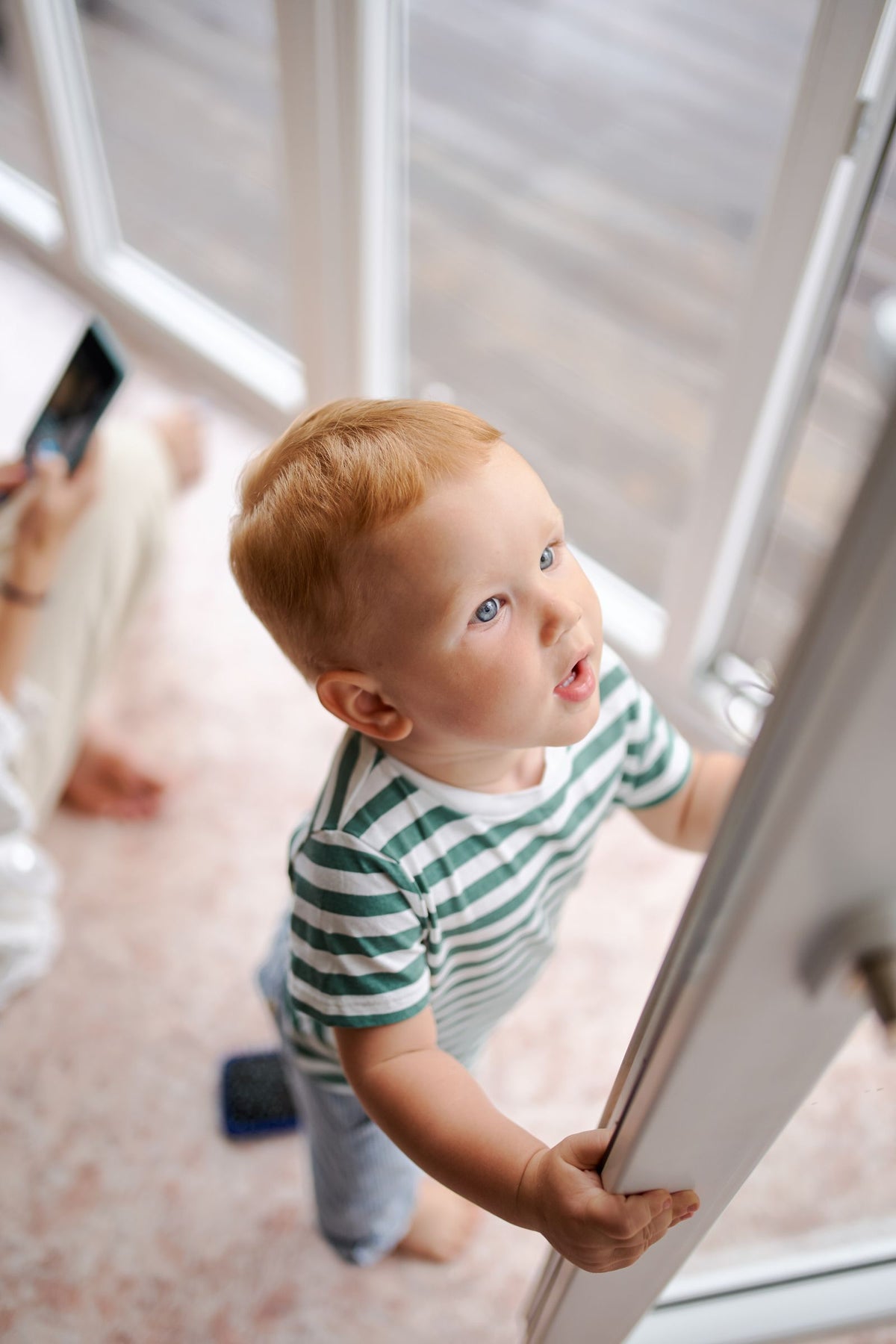
Doors are everywhere in a home, and toddlers are fascinated by them. They swing them, slam them and, sooner than you'd expect, work out how to open them. That brings two different risks: little fingers caught as a door closes, and a child who can suddenly wander into rooms, or outside, on their own.
This guide pulls together advice from the NHS, the HSE Child Safety Checklist and UK fire safety guidance, so you can protect fingers, manage which doors your toddler can open, and still get everyone out quickly in an emergency.
The short version: protect fingers on both sides of the door, keep toddlers out of rooms and spaces with hazards, never wedge open a fire door, and make sure every adult in the house can open the way out fast.
Finger trapping: both sides of the door
Trapped fingers are one of the most common door injuries for young children, and they can be serious. The British Association of Plastic, Reconstructive and Aesthetic Surgeons (BAPRAS) has urged parents to use door safety catches, estimating that tens of thousands of children injure their hands or fingers in closing doors every year, and that some of these injuries need surgery.
A door can catch fingers in two places:
- The closing edge, on the handle side, where the door meets the frame as it shuts.
- The hinge side, where a gap opens up between the door and the frame as the door swings open, then closes again as it shuts. Raising Children Network suggests finger protection strips to cover the gap on the hinge side.
The NHS notes that special devices which keep doors from closing fully can help protect your child's fingers, and the HSE checklist includes using safety door stoppers, fitted out of children's reach. Raising Children Network also suggests doorstops to reduce the chance of doors slamming suddenly, and wedges under doors so they don't swing closed on their own.
Door stoppers and wedges
- Finger guard door stoppers sit on the edge of the door and keep it from closing fully. A self-adhesive rotating door stopper, like ours, fits to the door edge and can be swung out of the way when you want the door to close.
- Rubber door wedges hold a door open so it can't swing shut in a draught. A heavy duty, non-slip wedge is designed to grip on carpet, wood, tile and laminate floors.
- Fit them out of reach where you can, as the HSE advises, and fit adhesive ones on a clean, dry, smooth surface, giving the adhesive time to bond.
Fire doors: never wedge or hold them open
This is the one rule that overrides everything above. Fire doors are designed to close on their own and hold back fire and smoke long enough for people to get out. The HSE checklist is clear that door stoppers should not be used on fire doors.
Greater Manchester Fire and Rescue Service explains that in a block of flats many doors will be fire doors, including your own flat front door and the doors on corridors, landings and stairways. Its advice:
- Don't wedge open fire doors. The service warns you could be committing a crime if you do.
- Don't remove or damage the self-closing device on your front door.
- Communal fire doors are usually marked 'Fire door keep shut' and should always close behind you.
- If you see a fire door wedged open, close it, and report any damage to your housing provider or managing agent.
Ordinary internal doors matter in a fire too. The NHS and the Home Office both advise closing inside doors at night to help contain a fire. So if you use wedges or finger guards on internal doors during the day, make taking them off and closing the doors part of your bedtime routine.
Lever handles and wandering toddlers
Once a toddler can reach up and pull down a lever handle, every room is open to them. Some spaces hold hazards your child shouldn't get to alone:
- The utility room, where laundry pods, detergents and cleaning products are often kept.
- The bathroom, with its water, medicines, razors and toiletries.
- A home office full of cables, chargers and small items.
- The garage or shed, with tools and garden chemicals.
- Front and back doors that lead to a road, a driveway, a pond or other water.
Locking hazards away is still the first step (our cupboard lock guide can help), but for rooms like these a door handle lock is designed to help keep a toddler from opening a door with a lever handle, while an adult can still open it. Raising Children Network also suggests fitting hook-and-eye latches high on doors, out of a child's reach.
Keep escape routes in mind
Any lock or latch you add should never trap anyone in a fire. The Home Office's fire safety advice for parents asks you to:
- Keep door and window keys where everyone can find them, including babysitters and childminders. The NHS also advises making sure all adults know where keys are kept in case of a fire.
- Keep all exits clear.
- Plan an escape route, think about how you'd get out if it were blocked, and practise the plan with your children.
Before fitting a handle lock to a front or back door, or a bedroom door on your escape route, check that every adult in the house can open it quickly, in the dark and in a hurry. If a device slows you down, it's on the wrong door.
Outside doors, gates, the road and water
A toddler who can open the back door can reach the garden, and from there possibly the road or water. The HSE checklist asks parents to make sure children can't get onto the road when they're playing outdoors, and to cover or completely fence off standing water such as ponds, barrels and water features. It also advises staying within arm's reach of your child whenever they're near water.
- Keep outside doors closed and locked when you're not using them, with keys kept somewhere every adult knows.
- Check garden gates and fences. The HSE advises blocking gaps in railings that a child could fit through or use as a foothold.
- Store paddling pools, buckets and containers after use so they don't collect rainwater, as the HSE recommends.
Glass, patio and sliding doors
Glass panels in doors sit right at toddler height, and a child running or falling into one can be badly hurt. The NHS advises:
- Use safety glass at low level, such as in doors and windows, as it shatters less easily than normal glass.
- Apply a shatter-resistant film to existing glass if replacing it isn't an option.
Patio and sliding doors often lead straight to the garden, so treat them like any other outside door and keep them closed and locked when you're not around.
Doors to the stairs and stair gates
Doors that open onto a staircase or landing need extra thought. The NHS advises fitting safety gates that meet BS EN 1930:2011 at the top and bottom of the stairs, closing them properly every time you go through, and keeping them in use until your child is at least 2. The HSE checklist also recommends correctly installed stair gates at the top and bottom, with the steps kept clear.
Teaching older toddlers about doors
As your child grows, you can start teaching them how to behave around doors. Raising Children Network suggests teaching children not to slam doors or play around them, and to keep their fingers away from the hinge side.
The NHS and the Home Office both recommend telling your children what to do in a fire and practising your escape plan together.
A final word
No home can be made completely risk-free, and no door stopper, wedge or lock replaces keeping an eye on your child. Use them as extra layers alongside supervision, and check your doors again each time your toddler learns something new (our stage-by-stage timeline shows what to expect), whether that's reaching handles, climbing or opening latches.
Sources
This guide draws on advice from the following organisations.
- Baby and toddler safety – NHS
- Child Safety Checklist for Parents – HSE
- Fire doors and why they are important – Greater Manchester Fire and Rescue Service
- Fire Safety for Parents and Child Carers – Home Office
- BAPRAS urges parents to use door safety catches (2017) – BAPRAS
- Doors and hinges: toddler safety – Raising Children Network
This guide offers general information for parents and is not a substitute for professional or medical advice. Always follow the manufacturer's instructions for any safety product and supervise children at all times.